New report challenges Net Zero feasibility for steel industry
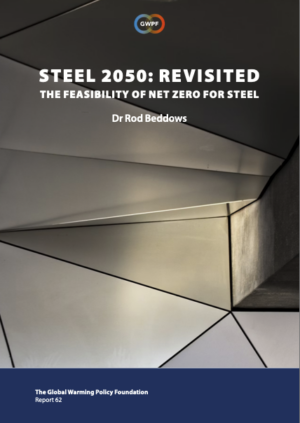
London, 22 July. The Global Warming Policy Foundation (GWPF) is proud to publish Steel 2050: Revisited by the late Dr Rod Beddows. The report describes the enormous logistical barriers to the sector of meeting Net Zero, instead offering a more pragmatic approach to decarbonisation.
“With more wisdom, and a better appreciation of the real world and its complexity, decarbonisation can be achieved,” Dr Beddows concludes in the report. “But not in the way we are attempting it now.”
Dr Beddows had an extensive career as a strategy and corporate adviser to CEOs and boards in metals and mining industries, predominantly in the ferrous sector. This experience covered businesses in over 30 jurisdictions, and he is fondly remembered by many colleagues.
The report lays out an achievable pathway to reduce emissions in steelmaking, including a phased transition from traditional blast furnaces to direct reduced iron (DRI) modules using natural gas, eventually shifting to green hydrogen if it becomes viable. However, it underscores that this transition will take decades and will require trillions in global investment, well beyond the funding capacity of the industry alone.
Dr Beddows also cautions against premature scrapping of viable industrial assets and criticises the overreliance on intermittent renewables, proposing instead that nuclear energy and natural gas play central roles in powering green steel in the coming decades.
Key conclusions from Steel 2050: Revisited include:
- Steel can be decarbonised, but not under current Net Zero timescales without sacrificing industrial stability and economic growth.
- Green hydrogen remains a distant solution, currently uneconomical and limited in scalability for near-term deployment.
- Mega-hubs backed by sovereign wealth funds and low-cost energy may lead the way in producing low-emissions steel at scale.
- Prematurely enforcing Net Zero mandates risks damaging productive industries and social cohesion, with questionable climate benefits.
The report explores the implications of green steel for related sectors such as automotive manufacturing and power generation, highlighting inconsistencies in emissions accounting and the undervalued costs of large-scale renewable infrastructure.
Head of policy, Harry Wilkinson, said:
“We were very fortunate that Dr Beddows was able to share with us his thoughtful reflections before he died. He had an enormous amount of experience in the ferrous sector, and his message of pragmatism and realism is one that policymakers urgently need to take to heart.”
Read the full report here – Steel 2050: Revisited (pdf)